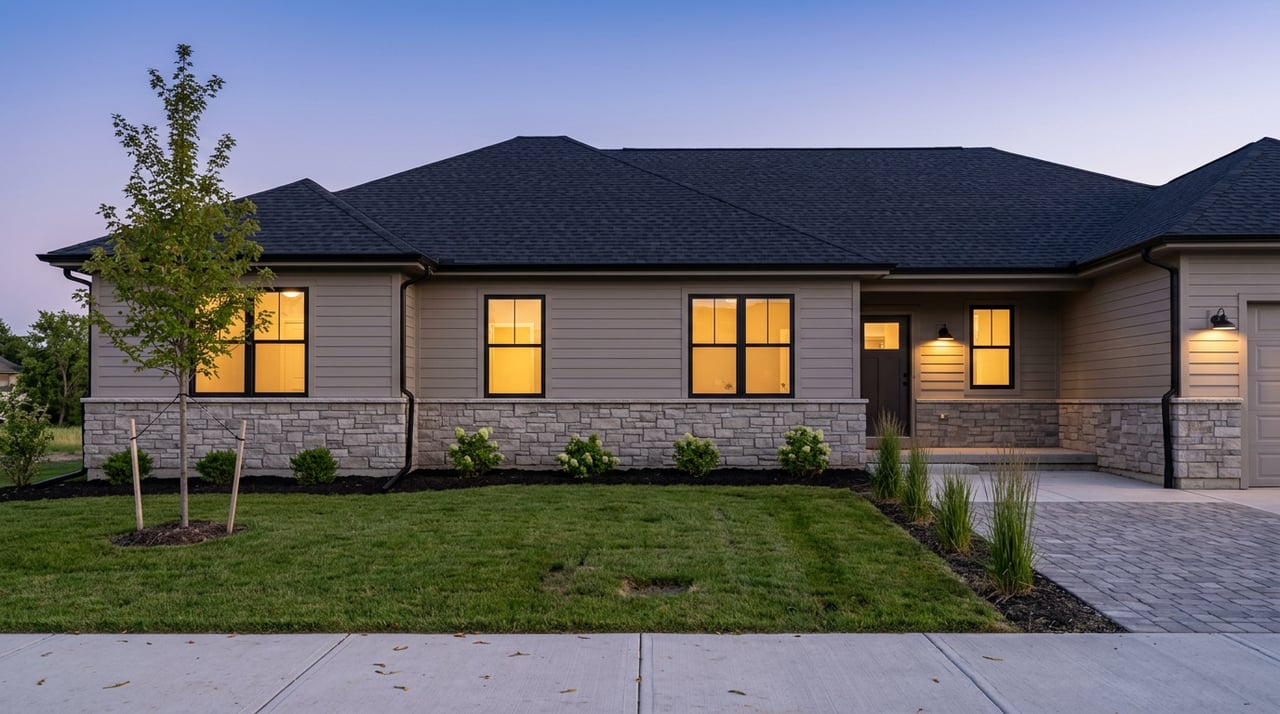
Drive down Wilmot Road past the old Walgreens corporate campus and you'll see the fencing, the earthmovers, and a sign for a new subdivision called Leclair Estates. Ask around and you'll hear that Deerfield is "finally building new homes." That's true, but it's only a third of what's actually happening on former commercial land in this village right now, and the part everyone notices from the road is the part least likely to change what you're competing against if you're shopping the resale market.
Three separate developers are converting underused office and retail land into housing at the same time in Deerfield. One is a luxury single-family subdivision. One is a large rental community. One is income-restricted senior housing. They share a permitting history and, in two cases, an affordable-housing requirement written into Deerfield's zoning code. They do not share a buyer pool, and understanding which is which matters more than knowing that "new construction is coming."
Three Projects, Three Different Kinds of Housing
Here's what's actually approved and underway, according to the Village of Deerfield's own development summary:
| Project | What It Is | Location | Who It's Built For |
|---|---|---|---|
| Leclair Estates | 42 detached single-family homes, roughly 2,722 to 3,899 square feet, built by Pulte Homes | North third of the former Walgreens corporate campus on Wilmot Road | Buyers who can compete above $950,000 |
| Springs at Lake Cook Crossing | 254-unit rental community in eight three-story, townhome-style buildings, built by Continental Properties | Rear 10.79 acres of Deerbrook Shopping Center, off Waukegan Road | Renters, with a pedestrian path planned to the Lake Cook Metra stop |
| Deerfield Supportive Living | 147-unit rental facility (141 studios, 6 one-bedroom units) for residents 65 and older, developed by Celedon Partners | 1111 Lake Cook Road | Seniors seeking supportive living, not homeownership |
Pulte's own listings for Leclair Estates currently price the plans between 2,722 and 3,391 square feet at $949,990 to $1,010,990. The village's larger 3,899-square-foot plans aren't yet priced publicly, but the entry point alone tells you this isn't affordability relief. It's new luxury inventory for buyers who were already shopping at that price band, whether in Deerfield or one town over.
Why a Built-Out Suburb Is Building at All
Deerfield hasn't had raw land to develop in years. What it has had, recently, is corporate real estate that no longer fits its original purpose. Walgreens consolidated its Deerfield headquarters and sold off the north third of its corporate campus, at 202, 300, 302 and 304 Wilmot Road, to Pulte. That sale is what created the 18-acre parcel Leclair Estates now sits on. Springs at Lake Cook Crossing is going up on the back acreage of a shopping center, not a subdivided farm field. The supportive living project replaced a single-story office building on Lake Cook Road.
None of this is new land. It's recycled land, and the reason it's available now is that the commercial and office uses it used to hold stopped earning their keep. If you're trying to predict where the next wave of Deerfield housing might come from, the pattern to watch isn't zoning maps. It's which office parks and strip retail sites are quietly losing tenants.
The Ordinance Shaping Every One of These Projects
Deerfield's zoning code has a section that rarely comes up in a listing conversation but explains a lot about what got built and how. Section 2.14, Affordable Housing in Governed Developments, defines a "governed development" as any project adding 30 or more single-family units or 11 or more multifamily units. Cross that threshold and the village requires a set percentage of the units to be sold or rented at an affordable rate, sized to the project.
Leclair Estates, at 42 lots, clears the single-family threshold, which is why three of its homes will be sold as affordable units rather than at market rate. Springs at Lake Cook Crossing, at 254 units, clears the multifamily threshold by a wide margin, which is why 25 of its units are designated affordable. Do the math and Leclair's set-aside works out to about 7 percent of the subdivision, while Springs' works out closer to 10 percent.
The supportive living project didn't need this ordinance at all. All 147 of its units are structured as affordable housing from the start, a different tool aimed at a different problem.
That distinction matters if you're thinking about how Deerfield handles growth. The village uses an inclusionary carve-out for market-rate projects and a fully income-restricted structure for the senior building. It isn't one policy. It's two, applied based on what kind of housing is being built and who it's meant to serve. Deerfield's local preference rule also gives priority to applicants who already live or work in the village, so even the affordable units skew toward people with an existing Deerfield connection rather than opening the door to a broader regional applicant pool.
Which of These Actually Loosens the Market You're Shopping In
Here's the part that gets skipped when people talk about Deerfield "adding housing." Not all new supply relieves the same pressure.
Leclair Estates adds 42 homes, but at a price point that competes with existing luxury resale and other new-construction options across the North Shore. It doesn't pull demand away from the $700,000 to $900,000 resale tier where most family buyers are actually competing. If anything, it gives move-up buyers already targeting that price range one more option to consider alongside an existing home.
Springs at Lake Cook Crossing adds 254 units, but they're rentals, not homes for sale. The buyers most likely to consider them are people who'd otherwise be renting somewhere else in the area, or who've been priced out of buying and are choosing to wait near a Metra stop instead of stretching for a mortgage. That can quietly reduce the number of would-be buyers competing for entry-level resale homes, but it does nothing to add inventory to the for-sale column.
The supportive living project is the one worth paying attention to if you're watching the single-family resale market specifically. It gives longtime Deerfield homeowners, many of whom are sitting in detached homes they no longer need the space for, a way to downsize without leaving the community they've lived in for decades. A senior who moves from a four-bedroom house into a studio or one-bedroom supportive living unit on Lake Cook Road puts that four-bedroom house back on the resale market. That's the one project of the three with a plausible path to adding inventory to the exact segment most buyers are shopping.
None of this means the supportive living building alone will move the needle on Deerfield's resale numbers. It's 147 units serving a fraction of the village's senior homeowners. But it's the only one of the three current projects with a mechanism that connects back to single-family turnover at all.
What the Current Resale Numbers Actually Show
As of late July 2026, one property-data tracker put Deerfield's village-wide median list price at roughly $725,000, or about $304 per square foot, with homes spending a median of 19 days on market. A separate tracker measuring the small pool of active new-construction listings specifically put that segment's median at $775,000, a premium of roughly 7 percent over the resale median, which is a reasonable proxy for what buyers are paying to skip the renovation list and get a warranty instead.
Those two trackers didn't agree on time-on-market either. One showed a 19-day median for July 2026. As of this writing, a separate live listing count drawing on the village's broader sales history put typical time on market closer to a month, with an average of six offers per sale. Neither number is wrong so much as noisy. Deerfield sold roughly 21 homes in a recent one-month stretch, and when a market that small gets measured, a handful of fast or slow sales can swing the headline figure meaningfully. If you're pricing a listing or timing an offer, a citywide median from any single source is a starting point, not a forecast. The block, the price band, and the week all matter more than the village-wide average.
Frequently Asked Questions
Will these new developments bring Deerfield home prices down? Not directly, and not soon. Leclair Estates is priced above most existing Deerfield resale inventory, and Springs at Lake Cook Crossing is rental housing, not for-sale supply. Neither adds meaningfully to the pool of homes buyers are competing for in the $700,000 to $900,000 range where most family buyers are shopping.
When will Leclair Estates homes be ready to move into? Sales are underway and homes are being built to order, so timelines vary by lot and floor plan. Buyers interested in a specific plan should confirm current construction timing directly, since availability shifts as lots sell.
Which schools serve the Leclair Estates subdivision? Based on the development's location, homes at Leclair Estates are assigned to South Park Elementary, Caruso Middle School, and Deerfield High School. Families should confirm current attendance boundaries directly with the district before making a decision based on assumed assignments.
If you're weighing a new-construction lot against an existing home in Deerfield, or you're a longtime homeowner wondering what your current house is actually worth in a market this tight, that's exactly the kind of pricing question that benefits from a local, data-backed read rather than a citywide average. Audra Casey tracks these Deerfield developments and the resale market around them month to month. Reach out for current market data and pre-market access before your next move.